
How to Fix Crooked Teeth without Braces: Best Alternative of Braces
 Medically Reviewed by Whistle Dental Team
You can successfully fix crooked teeth without braces using advanced dental alternatives, with clear aligners standing as the most effective biological treatment.
Today, you no longer have to endure visible metal brackets, sharp archwires, or painful food restrictions to straighten your smile.
Key Takeaways
- Clear Aligners Are the Gold Standard: Transparent plastic aligners physically shift misaligned roots and crowns into ideal alignment without metal wires, brackets, or dietary limitations.
- Cosmetic Masking vs. Orthodontic Movement: Dental veneers and composite bonding offer quick aesthetic fixes in 1 to 2 appointments, but they require irreversible enamel shaving and do not correct root misalignment or bite function.
- How Teeth Become Crooked: Genetic jaw size mismatch, prolonged mouth breathing, childhood thumb sucking, premature baby tooth loss, and tongue thrusting are primary causes of dental crowding and protrusion.
- Fixing Protruding (Buck) Teeth: Mild to severe protruding front teeth (overjets) are easily corrected with clear aligners paired with precision smart attachments and elastics, without needing noticeable metal train-tracks.
Depending on your dental alignment, modern options range from non-invasive clear aligners that physically guide your teeth into place to cosmetic restorations like dental veneers and composite bonding that mask surface imperfections.
For patients seeking genuine, long-term alignment across India, Whistle doctor-directed clear aligners provide a virtually invisible, comfortable, and predictable path to a confident smile starting from Rs. 60,000 to Rs. 2.5 Lakhs with flexible monthly EMI plans.
What Causes Teeth to Become Crooked?
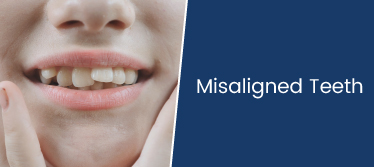
Many patients search for how teeth get crooked in the first place. Misaligned teeth (malocclusion) do not happen overnight; they develop due to specific skeletal, genetic, and childhood habit factors:
- Genetic Arch Discrepancies: If you inherit a smaller jawbone from one parent and larger teeth from the other, your dental arch simply lacks the physical perimeter needed for teeth to erupt in a straight line. This leads to overlapping, twisted, and crowded teeth.
- Prolonged Childhood Non-Nutritive Sucking: Thumb-sucking, pacifier use beyond age 3, or tongue-thrusting presses continuous forward force against developing upper incisors, leading to flared buck teeth (protruding overjets) and anterior open bites.
- Chronic Mouth Breathing and Airway Issues: Chronic nasal congestion, enlarged adenoids, or deviated septums force children to breathe through their mouths. This alters resting tongue posture from the roof of the mouth to the floor of the mouth, causing the upper jaw to develop into a narrow, high-vaulted V-shape with crowded front teeth.
- Early Loss of Primary (Baby) Teeth: When baby molars are lost prematurely to decay without space maintainers, adjacent teeth drift forward into the vacant gap, blocking the natural eruption path of permanent canine and premolar teeth.
- Adult Bruxism and Periodontal Bone Loss: Chronic night-time clenching or grinding exerts heavy lateral shear stresses on teeth. Combined with mild gum disease, this pressure causes gradual front-tooth flaring and spacing in adults over time.
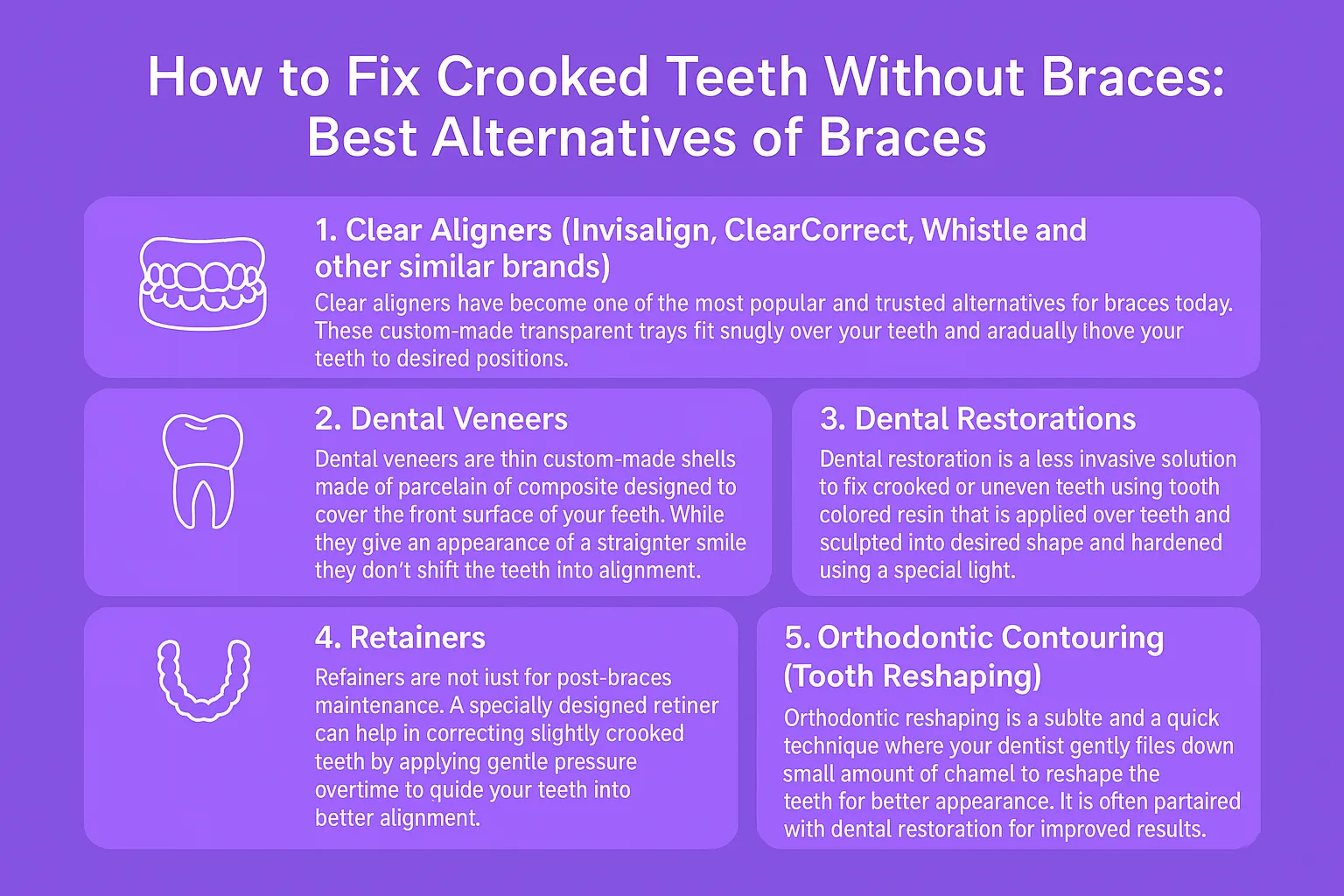
Crooked or misaligned teeth can develop due to a combination of genetic, skeletal, childhood, and adult factors. From inherited jaw-tooth size differences and childhood habits to mouth breathing, premature loss of baby teeth, and adult grinding or gum-related bone loss, several factors can affect how teeth align over time.
Top Clinical Methods to Fix Crooked Teeth Without Braces
Modern dentistry offers five primary treatment pathways to straighten teeth without traditional metal brackets. Here is how each method works clinically:
1. Custom Clear Aligners (The Best Long-Term Non-Braces Solution)
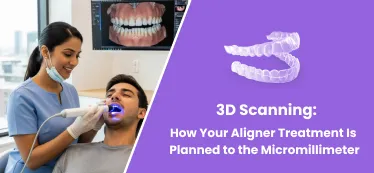
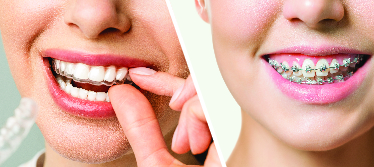
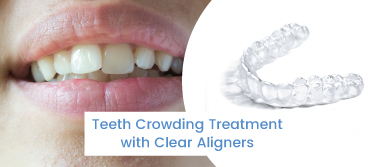
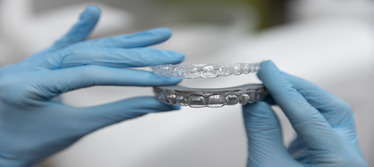
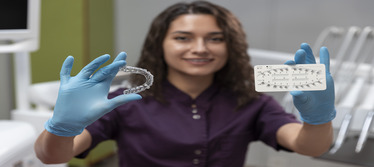
Clear aligners are medical-grade, transparent thermoplastic trays engineered to deliver sequential micromovements (0.2 mm to 0.25 mm per tray). Designed via digital 3D intraoral optical scans, you wear each tray for 20 to 22 hours daily, switching to a new set every 1 to 2 weeks. They physically straighten your roots, correct your bite, and preserve 100% of your natural enamel without any wires.
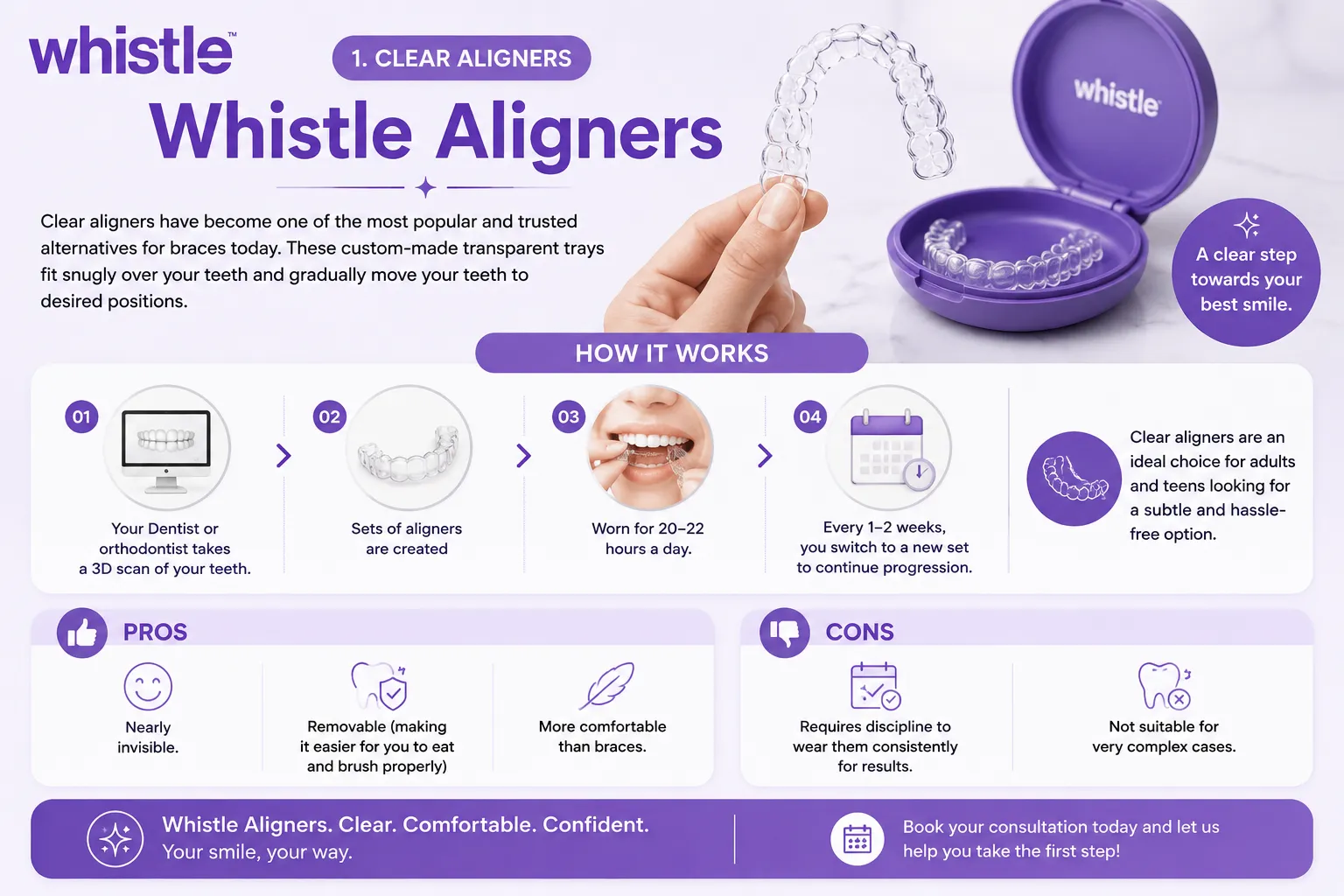 <
Benefits:
- Straightens teeth discreetly without visible metal braces.
- Can address many cases of crowding, spacing, and bite problems.
- Removable for eating, brushing, and flossing.
- Digital treatment planning allows patients to preview the expected tooth movement.
Pros:-
- Nearly invisible and more aesthetic.
- Easier to maintain oral hygiene compared with fixed braces.
- No wires or brackets that can irritate the cheeks.
- Removable when eating or for special occasions.
Cons:-
- Requires consistent wear, typically around 20–22 hours per day.
- May not be suitable for every complex orthodontic case.
- Can be more expensive than some conventional orthodontic treatments.
- Losing or damaging trays can add replacement costs or delay treatment.
2. Porcelain Veneers (Instant Cosmetic Camouflage)
Porcelain veneers are ultra-thin ceramic shells custom-bonded to the front surface of your teeth. They do not physically move your teeth; instead, they mask minor crookedness, uneven edges, and deep discoloration in 2 to 3 clinic visits. However, veneers require irreversible removal of 0.5 mm to 0.8 mm of healthy outer tooth enamel and must be replaced every 10 to 15 years.
Benefits
- Can quickly improve the appearance of mildly crooked, uneven, or discoloured teeth.
- Provides a natural-looking cosmetic result.
- Treatment can often be completed in a few appointments.
Pros
- Fast cosmetic transformation.
- Stain-resistant compared with natural teeth.
- Can improve tooth shape, size, colour, and minor alignment concerns simultaneously.
- Long-lasting when properly maintained.
Cons:-
- Does not actually move or straighten the teeth.
- Usually requires removal of some enamel.
- Not suitable for significant crowding or bite problems.
- Veneers may eventually need replacement.
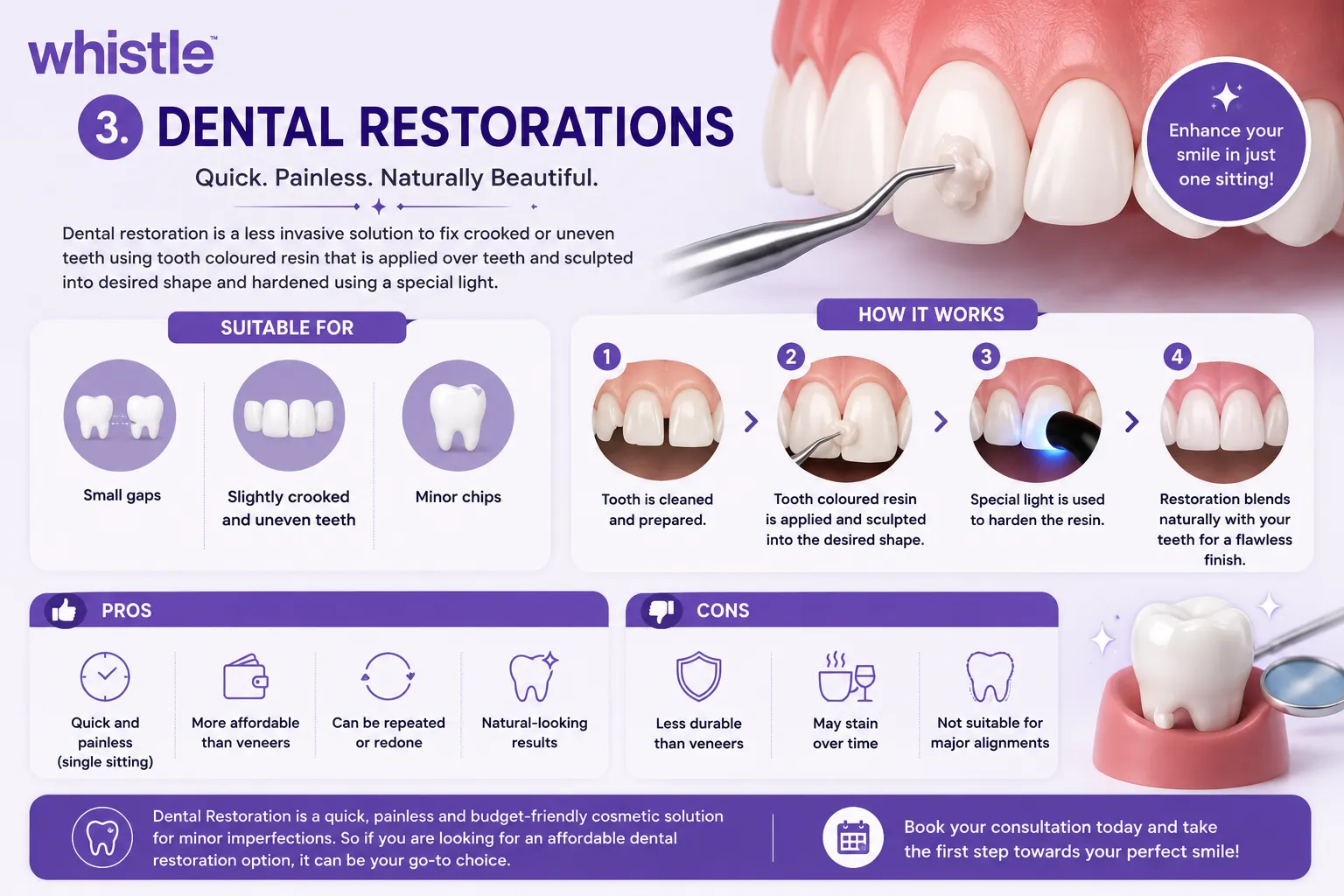
3. Direct Composite Bonding (Fast Aesthetic Contouring)
Often considered one of the quick fixes for crooked teeth, composite bonding involves applying tooth-colored resin directly to slightly rotated or chipped teeth. Your dentist sculpts the resin to create the visual illusion of straightness in a single sitting. While affordable, composite resin is prone to coffee and curry staining and has a lifespan of 3 to 7 years.
Benefits
- Can improve the appearance of slightly crooked, chipped, or uneven teeth.
- Often completed in a single dental visit.
- Requires little or no enamel removal in many cases.
Pros
- Quick cosmetic improvement.
- Generally more affordable than porcelain veneers.
- Minimally invasive.
- Composite can be repaired or modified relatively easily.
Cons
- Does not physically straighten teeth.
- More susceptible to staining and chipping than porcelain.
- Usually has a shorter lifespan than porcelain veneers.
- Best suited to minor cosmetic imperfections rather than significant misalignment.
4. Orthodontic Retainers (For Minor Post-Braces Relapse)
If you wore braces in your teenage years and experienced minor single-tooth shifting because you stopped wearing your retainer, a custom active spring retainer or clear realignment retainer can nudge that single tooth back into line over 2 to 4 months.
Benefits
- Can help correct minor tooth movement after previous orthodontic treatment.
- Useful for maintaining or regaining alignment in selected cases.
- Less noticeable and less invasive than full orthodontic treatment.
Pros
- Simple and relatively comfortable.
- Can be removable depending on the type.
- Useful for minor relapse.
- Generally less costly than comprehensive orthodontic treatment.
Cons
- Not suitable for significant tooth crowding or complex bite problems.
- Requires consistent use as advised by the orthodontist.
- May not be enough to correct larger tooth movements.
- Treatment time varies depending on the extent of relapse.
5. Palatal Expanders (For Narrow Jaws in Teens & Young Adults)
In growing adolescents and younger adults with severe dental crowding caused by a constricted palate, an orthopedic palatal expander gradually widens the upper jaw over several months, creating natural space for crooked teeth to align without extractions.
Benefits
- Creates additional space by widening a narrow upper arch.
- Can help address crowding associated with a constricted palate.
- May reduce the need for tooth extraction in suitable growing patients.
Pros
- Addresses the underlying width of the upper jaw rather than simply moving teeth.
- Particularly useful during childhood and adolescence when the jaw is still developing.
- Can create space for permanent teeth to erupt more naturally.
Cons
- Effectiveness decreases as jaw growth progresses.
- Can initially cause pressure or discomfort.
- May temporarily affect speech or eating.
- Requires regular monitoring and follow-up with an orthodontist.
How to Fix Protruding (Buck) Teeth Without Braces
- Precision Molar Distalization: Instead of pulling healthy premolars, your orthodontist uses sequential aligner staging to move your upper back molars backward one by one, creating room to retract flared front teeth.
- Interproximal Reduction (IPR): By safely polishing fractions of a millimeter (0.1 mm to 0.3 mm) of enamel between crowded side teeth, your orthodontist creates the necessary perimeter space to draw front teeth inward.
- Smart Composite Attachments & Class II Elastics: Tiny, tooth-colored aesthetic buttons placed on your side teeth connect discreet elastics that guide the upper and lower dental arches into balanced harmony.
- Controlled Incisor Retraction & Torque: Unlike rigid metal wires that can tilt teeth unnaturally, CAD-CAM aligners apply 3-dimensional torque to upright the tooth root, ensuring teeth are drawn back smoothly without loose roots or gum recession.
Want to Straighten Your Teeth Without Visible Wires?
Discover how Whistle clear aligners can fix crowding, gaps, or protruding teeth in just 6 to 12 months with flexible monthly EMI plans. Book Your Free 3D Smile Scan at your nearest Whistle Partner Clinic today!
Fixing Crooked Teeth with Clear Aligners in India
At Whistle partner clinics (600+ locations across India), clear aligner pricing is transparent and based strictly on the severity of your dental misalignment:
| Misalignment Category | Clinical Dental Conditions | Typical Aligner Steps | Expected Timeline |
| Mild Realignment | Minor front tooth overlapping, small gaps (1-2 mm), minor post-braces relapse | 10 to 16 Trays | 4 to 6 Months |
| Moderate Realignment | Noticeable crowding, twisted incisors, moderate overjet (protruding teeth), mild deep bite | 18 to 28 Trays | 7 to 12 Months |
| Complex Realignment | Severe multi-quadrant crowding, crossbites, severe overbite, premolar rotations | 30 to 45+ Trays | 12 to 18 Months |
Why Do Teeth Become Crooked?
Teeth rarely grow perfectly straight on their own. The most common culprits for dental crowding include:
- Genetics and Jaw Size: The most frequent cause is a simple physical mismatch. You may have inherited large teeth from one parent and a narrow jawbone from the other, leaving no room for the teeth to sit side-by-side.
- Childhood Habits: Prolonged thumb sucking or tongue thrusting pushes the front teeth forward and out of alignment.
- Early Tooth Loss: If a baby tooth falls out too early, the surrounding adult teeth drift into the empty space, blocking the new adult tooth from erupting straight.
- Wisdom Teeth Eruption: In your late teens or early twenties, erupting wisdom teeth can push heavily against your back molars, causing a domino effect that crowds your front teeth.
Orthodontist Observation Layer: 5 Critical Mistakes Aligner Patients Make
Our senior orthodontic specialists across Whistle partner clinics see hundreds of non-braces transformations each month. To get the fastest, crispest smile results, avoid these common daily mistakes:
- Falling for Dangerous Social Media "DIY Braces" Hacks: Using household rubber bands, hair ties, or paperclips to pull crooked teeth together creates uncontrolled tipping forces. Rubber bands slip underneath the gumline, destroying the periodontal ligament, cutting off blood supply, and causing healthy teeth to fall out completely.
- Wrapping Clear Aligners in Dining Tissues: During lunch at work or festive dinners, taking off aligners and wrapping them in paper napkins almost always leads to them being thrown in the garbage bin. Always keep your hard Whistle case with you.
- Rinsing Trays in Hot Tap Water: Clear aligner polymers are thermoformed under high temperatures. Cleaning trays with warm or boiling water distorts their micromillimeter calibration, ruining tooth tracking. Use cool or room-temperature water only.
- Neglecting the Mandatory 22-Hour Wear Clock: Aligners only work when they are on your teeth. Removing them for 4 to 6 hours during social outings stalls cellular bone remodeling, forcing teeth to lag behind schedule.
- Forgetting to Use Aligner Chewies: Using your fingers alone to seat your aligners often leaves tiny air gaps. Chewing gently on silicone chewies for 3 to 5 minutes twice daily ensures full surface contact and delivers exact biomechanical forces.
Daily Care and Lifestyle Guide for Straightening Teeth Discreetly
Straightening teeth with clear aligners integrates effortlessly into your professional and personal lifestyle:
- Protecting Trays from Turmeric and Spices: While clear aligners are completely stain-resistant, eating rich gravies with trays in will stain the plastic yellow. Remove your aligners before eating Indian curries, rinse your mouth thoroughly, and brush before reinserting.
- Daily Cleaning Protocol: Clean your aligners twice daily using a soft toothbrush and clear antibacterial liquid soap. Do not use gritty whitening toothpaste, which leaves micro-scratches that harbor plaque bacteria.
- Flawless Confidence for Social & Work Events: Whether attending a wedding, giving an office presentation, or taking photos, your aligners remain completely invisible to friends and colleagues.
Can You Fix Your Crooked Teeth At Home?
You may have seen DIY methods or at home aligner kits available online. While some users report positive experiences, there are also risks involved:
- No in-person dental supervision.
- May overlook deeper dental issues.
- Results may vary or can be unsatisfactory
- Can do more harm than good.
Consult your dentist before considering this route as sometimes trying to fix crooked teeth without professional guidance can cause more problems than solving the issue at hand.
Structural vs. Cosmetic: Choosing Your Path
- Structural Correction: You physically move the tooth root through the jawbone into the correct anatomical position. (Examples: Clear Aligners, Retainers). This is the healthiest long-term option.
- Cosmetic Camouflage: The tooth root stays exactly where it is. The dentist simply shaves down the crooked part of the tooth and covers it with a straight-looking shell. (Examples: Veneers, Composite Bonding). This provides instant gratification but alters the natural tooth structure permanently.
Risks of Leaving Crooked Teeth Untreated
Crooked teeth are often seen as a cosmetic concern, but in many cases, they can also affect your oral health and overall well-being. When teeth are not properly aligned, they become harder to clean, may place uneven pressure on your bite, and can increase the risk of long-term dental problems. While not every case requires immediate treatment, addressing crooked teeth early can help prevent future complications.
1. Increased Risk of Tooth Decay
Crooked or overlapping teeth create tight spaces where plaque and food particles can accumulate. These areas are difficult to reach with regular brushing and flossing, increasing the likelihood of cavities and enamel damage over time.
2. Higher Chance of Gum Disease
When plaque builds up around crowded teeth, it can irritate the gums and lead to gingivitis. If left untreated, this may progress to periodontal (gum) disease, which can damage the tissues and bone supporting your teeth.
3. Uneven Tooth Wear
Misaligned teeth often do not meet evenly when you bite or chew. This uneven pressure can cause excessive wear on certain teeth, increasing the risk of chipping, cracks, and enamel erosion.
4. Bite and Jaw Problems
Crooked teeth can affect the way your upper and lower teeth fit together. Over time, this may contribute to bite problems, jaw discomfort, headaches, or symptoms associated with temporomandibular joint (TMJ) disorders.
5. Difficulty Chewing and Speaking
Severe misalignment can make it harder to chew food efficiently or pronounce certain words clearly. Correcting the alignment can improve both oral function and everyday comfort.
6. Lower Self-Confidence
For many people, crooked teeth can affect confidence when smiling, speaking, or interacting socially. Improving tooth alignment can enhance both appearance and self-esteem, contributing to a better quality of life.
What Affects the Cost of Treatment?
The final cost of treatment can vary based on several factors, including:
- The severity of crooked teeth or spacing issues.
- The type of treatment recommended by your dentist or orthodontist.
- Whether multiple teeth or only a single tooth requires correction.
- The overall treatment duration and complexity.
- Any additional dental procedures needed before treatment.
Note: Whistle currently provides pricing information for Clear Aligners, with treatment starting from ₹60,000. The cost of other treatments may vary depending on your individual treatment plan. A consultation with a dental professional is the best way to receive an accurate estimate.
Your Next Steps
You no longer have to choose between a crooked smile and years of metal braces. Modern dentistry offers elegant, fast, and virtually invisible ways to achieve the smile you want. Whether you opt for the structural perfection of Whistle clear aligners or the instant aesthetic upgrade of dental veneers, the choice is yours.
Stop hiding your smile in photos. Book a free consultation at your nearest Whistle Partner clinic today to design your personalized treatment plan.
- How to wear Aligners - A Complete Guide
- Inivisible Aligners Cost in India: Affordable, Comfortable & Expert-Backed Treatment
- The Process of Getting Teeth Aligners and What to Expect
Book 3D Teeth Scan
Consult our experts and get a 3D preview of your smile transformation!
How to Fix Crooked Teeth without Braces
FAQ's
Q1.Can you really fix crooked teeth without metal braces?
Q2.How to shape your teeth without braces?
You can shape your teeth without braces through cosmetic dental treatments like veneers, bonding, or contouring. These procedures reshape or cover the teeth to give them a straighter and more even appearance.
Q3.How to fix crooked teeth without braces?
Crooked teeth can be fixed without braces using clear aligners, dental veneers, or bonding. Aligners gradually move teeth into position, while veneers instantly improve alignment and appearance.
Q4.How to align teeth without braces?
Clear aligners are the best option to align teeth without braces. They use a series of removable trays that gradually shift teeth into the desired position while being discreet and comfortable.
Q5.How to fix protruding teeth without braces?
Protruding teeth can be fixed with clear aligners, veneers, or, in some cases, cosmetic contouring. Aligners work gradually, while veneers provide an instant improvement in appearance.
Q6.How to fix crooked teeth without braces naturally?
You cannot physically move crooked teeth "naturally" without clinical intervention. DIY methods like pushing on your teeth with your fingers or using rubber bands are incredibly dangerous and will cause permanent nerve damage and tooth loss. You must use clinically approved aligners or cosmetic dentistry.
Q7.Is composite bonding cheaper than clear aligners?
Generally, yes. Because composite bonding is completed in a single clinic visit and only targets one or two specific teeth, the upfront cost is lower than comprehensive orthodontic alignment. However, bonding may need to be replaced every 5 to 7 years.
Q8.Can I get clear aligners if I already have dental crowns?
Yes, Clear aligners can easily be designed to fit over and gently move teeth that have dental crowns. This makes them a highly versatile option for adult patients with previous dental work.

 Medically Reviewed by Whistle Dental Team
 Medically Reviewed by Whistle Dental Team

 Medically Reviewed by Whistle Dental Team