
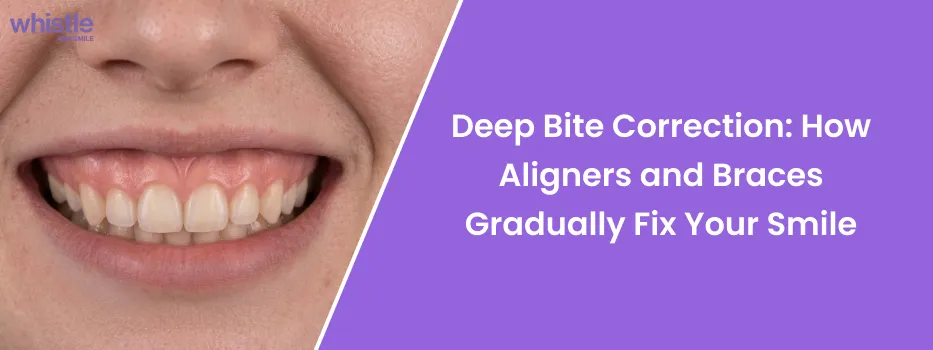
Deep Bite Correction: The Mechanics of Opening Your Bite
 Medically Reviewed by Whistle Dental Team
A deep bite (excessive vertical overbite) is treated primarily through orthodontic treatments like clear aligners for deep bite or specialized braces for deep bite to reposition teeth and align the jaw vertically.
When upper front teeth cover more than 30% to 50% of the lower teeth, clinical deep bite correction becomes necessary to prevent premature enamel wear, stop painful palate ulcerations, and relieve temporomandibular joint (TMJ) strain.
Key Takeaways
- Core Treatment Modalities: Deep bites are corrected using clear aligners with built-in bite ramps, modern self-ligating braces, bite turbos, restorative crowns, or orthognathic surgery in severe adult skeletal cases.
- How Bite Opening Works: Orthodontists coordinate anterior intrusion (pushing front teeth into the jawbone) and posterior extrusion (lifting back teeth outward) to flatten the Curve of Spee.
- Facial Aesthetic Rejuvenation: Opening a collapsed deep bite elongates the lower third of the face, enhances chin projection, softens thin strained lips, and relieves chronic jaw clenching tension.
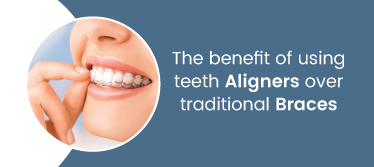
- Clear Aligners vs. Braces: Modern clear aligners equipped with lingual bite ramps offer a virtually invisible, removable, and comfortable solution for mild to complex deep bites without wire emergencies or food bans.
- Transparent Whistle Pricing: Treatment at Whistle partner clinics ranges strictly between Rs. 60,000 and Rs. 2.5 Lakhs based on case complexity, backed by flexible monthly EMI options.
Treatment relies on precise biomechanical forces: Intruding (pushing in) over-erupted front teeth, extruding (lifting out) back molars, or using a combination of both. Beyond protecting your oral health, correcting a deep overbite produces a noticeable deep bite face change, restoring collapsed lower facial height and defining your jawline.
Across 600+ physical Whistle partner clinics nationwide, doctor-directed clear aligner treatments range strictly between Rs. 60,000 and Rs. 2.5 Lakhs with flexible monthly EMI options available.
What Exactly is a Deep Bite and their Treatment Options
In a perfectly balanced smile, your upper teeth sit just slightly in front of your lower teeth when you close your mouth. Think of it like a gentle lid on a box, overlapping by about 2 to 3 millimeters (roughly 20% to 30% of the lower teeth's height).
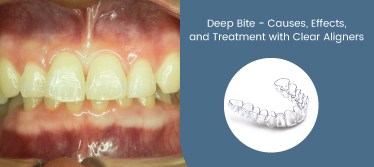
A deep bite occurs when that vertical overlap is much more pronounced. In severe cases, the upper teeth completely cover the lower teeth, sometimes to the point where the lower teeth press painfully into the gum tissue or the roof of your mouth.
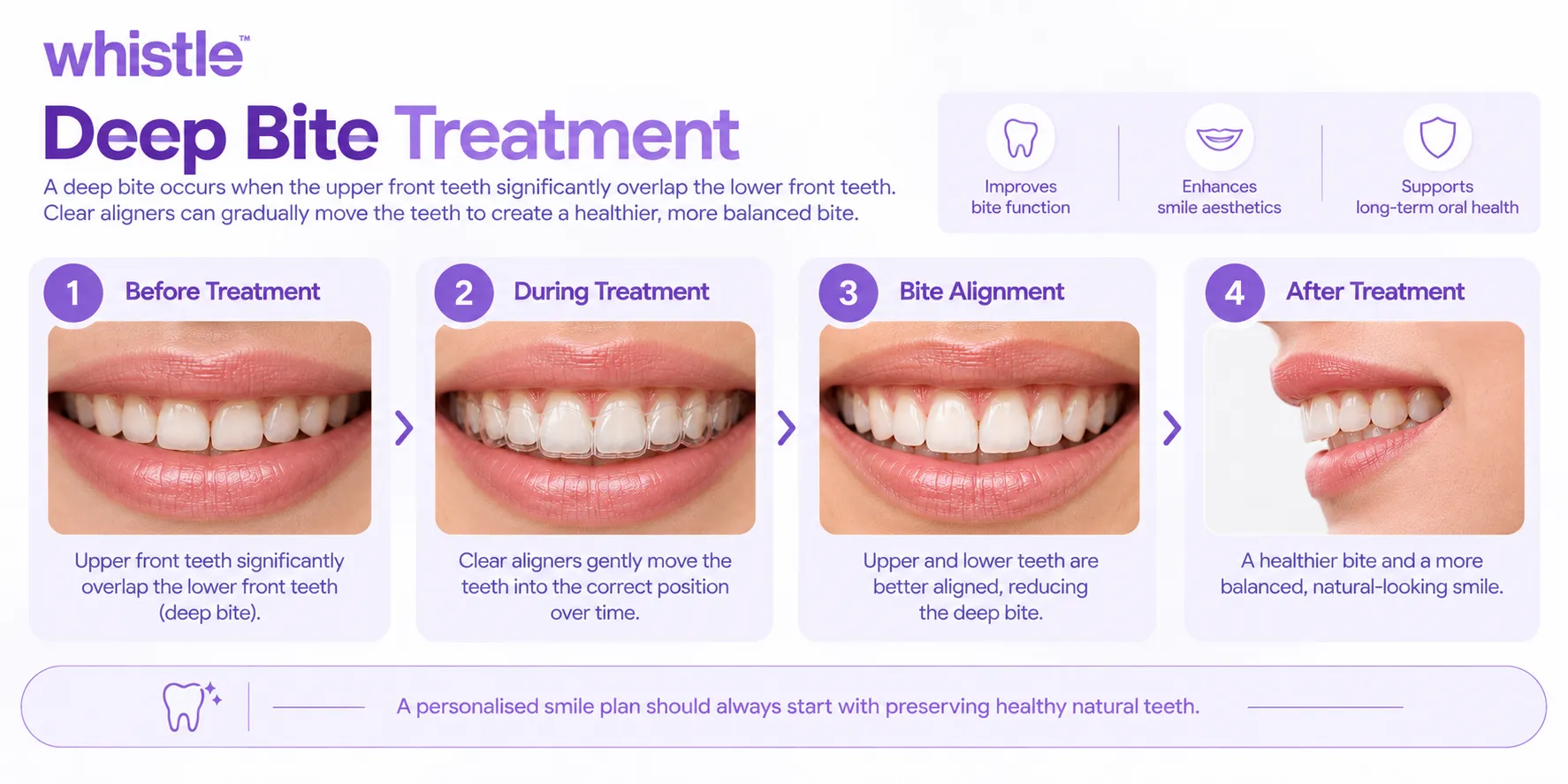
Common Treatment Options for Deep Bite Correction
Modern dental science offers five primary clinical options to open an excessive vertical overbite, depending on whether the issue is dental, skeletal, or related to worn-down back teeth:
1. Custom Clear Aligners with Bite Ramps (The Modern Non-Braces Choice)
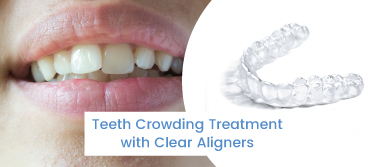
Clear aligners are removable, transparent thermoplastic trays engineered to deliver sequential micromovements. For deep bite cases, Whistle clear aligners feature precision-engineered lingual bite ramps (bite turbos) on the back surfaces of the upper front trays.
When you close your mouth, your lower incisors contact these ramps, temporarily discluding (separating) your back molars. This accomplishes two things simultaneously: it applies continuous intrusive pressure on the front teeth while creating vertical space for back molars to extrude naturally into proper alignment.
2. Traditional and Modern Self-Ligating Braces
Metal or ceramic brackets bonded to each tooth utilize continuous archwire mechanics to level the dental arches.
In deep bite cases, orthodontists use specialized reverse Curve of Spee archwires combined with intermaxillary vertical elastics to actively depress front teeth while elevating premolars and molars over a 12 to 24 month timeline.
3. Bite Turbos or Posterior Disclusion Pads
Bite turbos (small medical composite or acrylic blocks) are temporarily bonded behind the upper front teeth or onto the biting surfaces of back molars.
They act as mechanical stops that physically prevent the patient from biting down completely into the deep overlap, freeing up the dental arches for rapid orthodontic movement and preventing brackets from being sheared off by upper teeth.
4. Restorative Dentistry (Crowns, onlays, and Composite Bonding)
In mature adult patients whose deep bite was caused or worsened by severe bruxism (teeth grinding) or missing back molars, orthodontics alone may not replace lost tooth structure.
Restorative dentistry uses full-coverage zirconia crowns, ceramic onlays, or direct composite bonding to rebuild the worn occlusal height of posterior teeth, restoring the collapsed vertical dimension of the mouth.
5. Orthognathic Surgery (Surgical Orthodontics)
For severe, non-growing adult skeletal Class II deep bites with significant jaw size discrepancies (such as a severely retruded lower jaw), orthodontic appliances alone cannot bridge the skeletal gap.
In these rare cases, orthognathic jaw surgery is performed in hospital alongside pre- and post-surgical orthodontics to reposition the jawbones into anatomical balance.
What Causes a Deep Bite?
Deep bites rarely happen by accident. They are typically the result of skeletal genetics or missing teeth.
- Genetics: A naturally short lower jaw or a disproportionately large upper jaw causes the upper teeth to drape completely over the lower ones.
- Missing Back Teeth: If you lose your back molars and do not replace them, your bite slowly collapses. The vertical height of your face drops, causing the front teeth to overlap deeply.
- Chronic Clenching: Years of severe bruxism (teeth grinding) wears down the back teeth, leading to a collapsed, deep bite.
Why Should You Correct a Deep Bite?
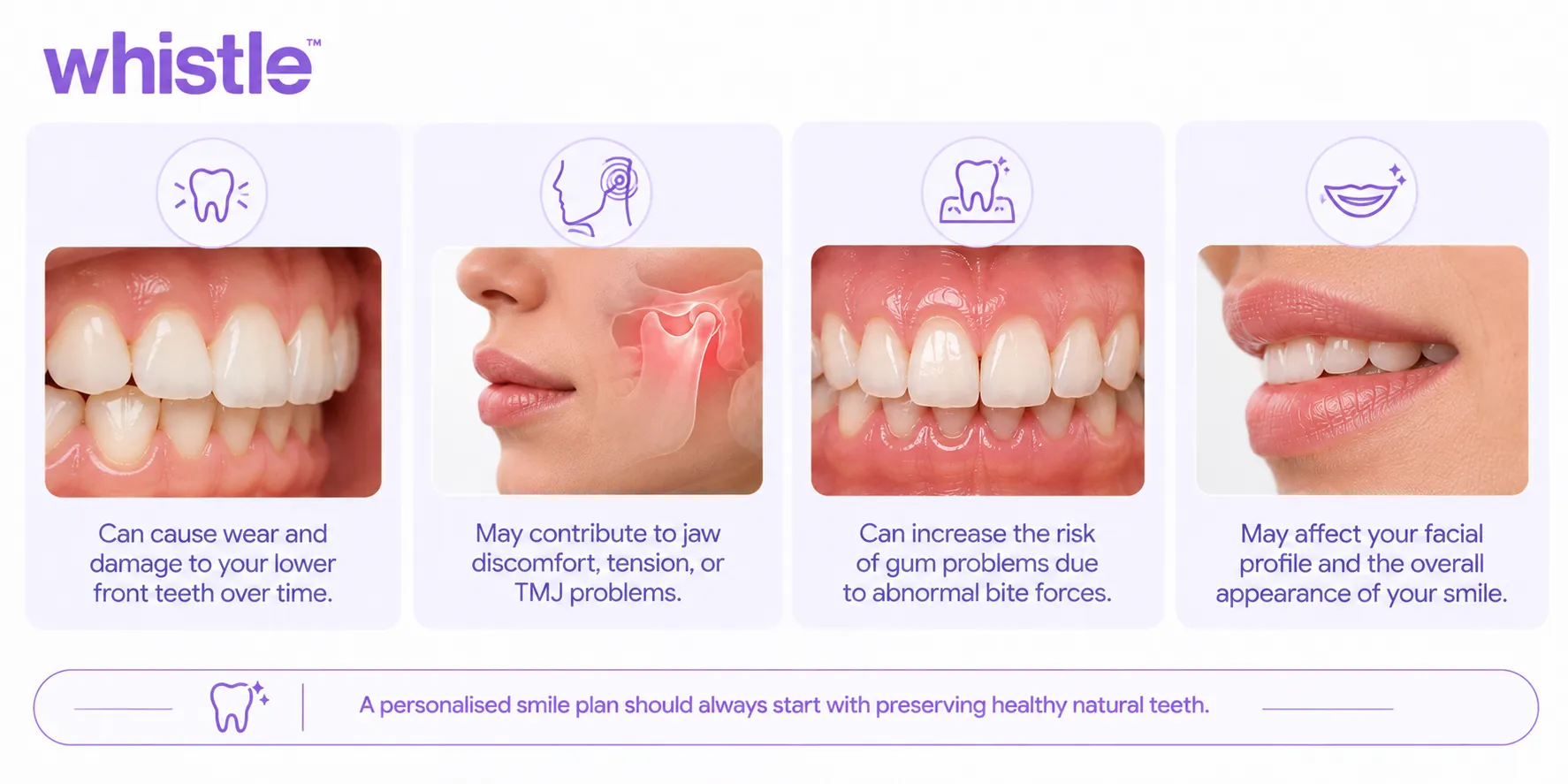
Living with a deep bite is often like driving a car with misaligned tires. It might move fine for a while, but over time, uneven friction causes avoidable wear and tear. Leaving a deep bite unaddressed can lead to:
- Premature Teeth Damage: Because the teeth don't meet evenly, the edges of your lower front teeth constantly grind against the backs of your upper teeth, scraping away protective enamel.
- Jaw Joint Strain (TMJ): A deep bite forces the lower jaw backward, compressing the delicate structures of the temporomandibular joint (TMJ), which can cause chronic headaches or clicking sounds.
- Gum and Palate Trauma: When lower teeth make contact with the soft tissue behind the upper teeth, it can lead to painful scrapes, irritation, and bleeding.
How Deep Bite Correction Works: The 3 Biomechanical Movements
To successfully open a closed bite, orthodontic engineering levels the Curve of Spee (the natural vertical dip in the lower arch) using three core biological movements:
- Anterior Intrusion (Pushing Front Teeth Inward): Calibrated, continuous light pressure gently pushes over-erupted upper and lower front teeth back into their supporting jawbone housing (typically 1.5 mm to 3 mm). This reduces the excessive vertical overlap directly.
- Posterior Extrusion (Lifting Back Teeth Outward): Back premolars and molars are gently elongated or lifted upward by 1 to 2 mm. Because the human jaw functions like a mechanical hinge, lifting back molars by just 1 mm creates an opening of 2 mm to 3 mm at the front incisors.
- Combination Mechanics (The Gold Standard): In comprehensive clear aligner treatment, orthodontists program simultaneous anterior intrusion and posterior extrusion. Combining both movements provides maximum vertical stability, protects tooth roots, and prevents treatment relapse.
Why You Must Not Ignore a Deep Bite
- Premature Teeth Damage: Because the teeth do not meet evenly, the edges of your lower front teeth constantly grind into the backs of your upper teeth, stripping away the protective enamel and leaving the softer dentin exposed to decay.
- Jaw Joint Strain (TMJ): A deep bite physically traps the lower jaw, forcing it backward. This compresses the delicate cartilage in your temporomandibular joint (TMJ), causing chronic headaches and jaw clicking.
- Gum and Palate Trauma: In severe cases, the lower teeth bite directly into the soft tissue of the palate (the roof of the mouth) behind the upper teeth, leading to painful sores, bleeding, and permanent gum recession.
What Happens If You Leave a Deep Bite Untreated?
- Severe Enamel Erosion: The edges of lower front teeth constantly scrape against the backs of upper teeth, stripping away enamel and exposing softer dentin.
- Traumatic Palatal Ulcerations: Lower incisors bite directly into the soft gum tissue behind upper teeth, leading to painful chronic sores and gum recession.
- TMJ Dysfunction & Headaches: Trapping the lower jaw in a backward position compresses the temporomandibular joint, causing jaw clicking, neck stiffness, and chronic tension headaches.
- Inability to Receive Cosmetic Restorations: Dentists cannot place crowns, veneers, or implants on worn front teeth because there is zero vertical clearance until the bite is opened orthodontically.
Deep Bite Treatment Cost in India at Whistle Partner Clinics
At Whistle partner clinics across India, doctor-directed clear aligner treatment for deep bite correction is completely transparent, ranging strictly between Rs. 60,000 and Rs. 2.5 Lakhs based on diagnostic case complexity:
| Treatment Plan | Typical Aligner Sets | Estimated Duration |
| Whistle Express/Mild | Relapse after braces, Minor spacing, Mild crowding | 6-12 months |
| Whistle Moderate | Moderate crowding, Minor protrusion, Gap closure | 24 months |
| Whistle Complex | Severe crowding, Bite correction, Complex cases | 36 months |
What Is Included in the Deep Bite Treatment Cost at Whistle Partner Clinics?
- Initial orthodontic consultation – Assessment of your bite, teeth alignment, and overall orthodontic needs.
- Digital teeth scanning and treatment planning – Digital scans may be used to understand your current bite and create a personalised treatment plan.
- Customised aligners or orthodontic appliances – If clear aligners are suitable for your deep bite, the treatment cost includes the aligners planned for your case.
- Orthodontist-guided treatment – Your treatment is planned and supervised by a qualified dental professional at the partner clinic.
- Regular progress monitoring – Follow-up appointments help track tooth movement and bite correction throughout treatment.
Orthodontist Observation Layer: 5 Critical Mistakes Deep Bite Patients Make
Our senior orthodontic specialists across Whistle partner clinics observe these common patient mistakes during deep bite care:
1. Placing Cosmetic Veneers Before Correcting the Deep Bite: Patients frequently request porcelain veneers to cover worn front teeth. However, placing veneers on a deep bite without opening vertical clearance first causes the ceramic shells to fracture under heavy biting forces. Always correct the bite first.
2. Biting Down with Aligners Off During Daytime Clenching: Clenching raw teeth together pushes molars back into the jawbone, undoing extrusion progress. Wear your aligners for the mandatory 22 hours daily.
3. Skipping Silicone Chewies on Anterior Bite Ramps: Whistle clear aligners for deep bite feature built-in lingual bite ramps. Biting gently on silicone chewies for 3 to 5 minutes twice daily ensures front incisors fully engage the ramps for maximum intrusive force.
4. Neglecting Post-Treatment Retainers: Deep bites have a natural biological tendency to relapse vertically if retainers are neglected. Wearing custom clear retainers maintains bone stability permanently.
5. Cleaning Trays with Warm or Hot Water: Clear aligner polymers are precision thermoformed. Washing them with warm tap water warps the bite ramps, ruining calibrated vertical mechanics. Always rinse trays with cool or room-temperature water.
What to Expect: The Timeline of a Balanced Smile
Fixing a deep bite is a journey of patience. Moving teeth too quickly can damage their root structures, so your treatment is carefully timed to happen safely and gradually.
- The First Few Weeks: Whether you choose Whistle braces or aligners, you will feel a mild pressure as your bone structure adapts to the new forces. This is a sign that the rebalancing process has begun.
- The 6 to 12 Month Mark: This is where visual changes become distinct. As the Curve of Spee flattens, your lower front teeth will slowly begin to reveal themselves when you smile.
- Total Treatment Time: Depending on whether your case is moderate or comprehensive, deep bite corrections typically span between 12 to 24 months.
Your Next Steps
A deep bite does not just hold back the aesthetics of your smile; it places unnecessary, destructive stress on your teeth and jaw joints every single day. Correcting it is one of the most brilliant investments you can make for your long-term oral health and daily comfort.
A deep bite doesn't just hold back your smile, it places unnecessary stress on your teeth and jaws every single day. Correcting it is one of the best investments you can make for your long-term oral health and daily comfort.
Take the first step toward a healthier, more balanced smile today. Head over to our website to explore our options or take a quick assessment to find a Whistle partner clinic near you!
Also Read
Book 3D Teeth Scan
Consult our experts and get a 3D preview of your smile transformation!
Deep Bite Correction
Deep Bite Treatment
Deep Bite Aligners
Deep Bite Braces
Clear Aligners for Deep Bite
Orthodontic Treatment
Bite Correction
Teeth Alignment
Overbite Treatment
Dental Health
Smile Correction
Whistle Aligners
FAQ's
Q1.Can a deep bite be fixed without surgery?
Yes, the vast majority of dental deep bites can be completely corrected without surgery using modern orthodontic appliances like clear aligners or braces. Jaw surgery is typically only reserved for severe, skeletal deep bites in adults, where the underlying lower jaw bone itself is significantly underdeveloped or set too far back. For most smiles, high-quality products like Whistle aligners combined with the supervision of a partner doctor can beautifully rebalance the bite.
Q2.Is a deep bite the same thing as an overbite?
Not quite, though they are close cousins! An overbite refers to the horizontal distance your top teeth stick out in front of your lower teeth (think "buck teeth"). A deep bite is a purely vertical measurement, it’s about how far down your top teeth hang over your lower teeth, hiding them from view. It is very common to have both an overbite and a deep bite at the same time.
Q3.Will correcting a deep bite change my face shape?
Yes, but in a very positive, subtle way. A severe deep bite often causes the lower jaw to over-close, which can make the lower third of the face look shorter and cause the chin to appear slightly collapsed. By gradually lifting the back teeth and opening up the bite, orthodontics can gently elongate the lower face, giving you a more balanced profile and a more natural, relaxed jawline.
Q4.Can Whistle clear aligners fix a deep bite as effectively as traditional braces?
Absolutely. While old-school plastic aligners struggled with vertical movements, Whistle aligners are engineered specifically for complex cases. Because they are made from our proprietary 3-layer polyurethane material and feature built-in precision bite ramps, they give your doctor the exact mechanical leverage needed to press the front teeth down and lift the back teeth efficiently.
Q5.What happens if I choose to leave my deep bite untreated?
Leaving a deep bite alone can lead to progressive dental damage over time. Because your teeth don't align correctly, the constant friction can prematurely flatten and chip your front teeth's enamel. Many adults with untreated deep bites also experience painful issues like their lower teeth cutting into the roof of their mouth, chronic jaw joint (TMJ) soreness, and unexplained headaches from constant muscle tension.
Q6.Which local dentists can fix overbites or deep bites using clear braces?
Orthodontists and dentists with experience in clear aligner and braces treatment can correct mild to severe overbites and deep bites. Look for providers who offer comprehensive bite assessments, digital scans, and customized treatment plans tailored to your specific alignment needs.
Q7.What happens if I choose to leave my deep bite untreated?
Leaving it untreated leads to progressive dental destruction. The constant friction strips enamel, leaving teeth vulnerable to decay. You may also experience chronic temporomandibular joint (TMJ) soreness and tension headaches from the trapped jaw position.

 Medically Reviewed by Whistle Dental Team
 Medically Reviewed by Whistle Dental Team









 Medically Reviewed by Whistle Dental Team