
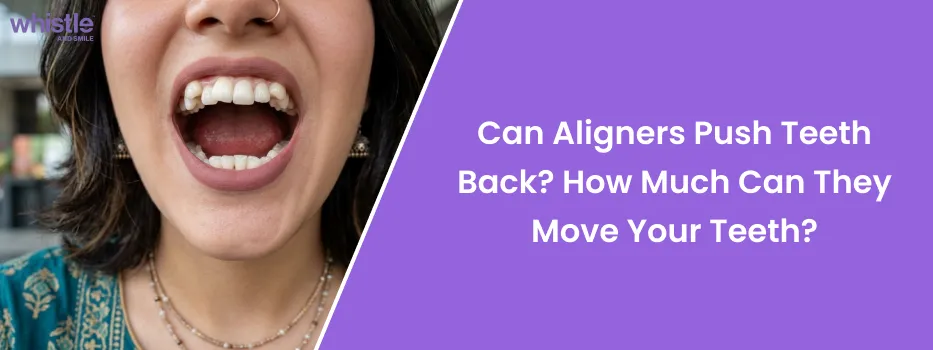
Can Aligners Push Teeth Back? How Far They Move and How It Works
 Medically Reviewed by Whistle Dental Team
Yes, clear aligners can safely push teeth backward through two primary methods: anterior retraction, which pulls flared front teeth inward to fix protrusion, and molar distalization, which shifts back chewing teeth toward the rear of the jaw to create space without extractions.
Clear aligners also gently guide teeth back into place if they have shifted or relapsed after previous braces treatment. By applying calibrated, continuous pressure of roughly 0.2 millimeters per tray alongside custom composite attachments, aligners remodel bone tissue safely without damaging roots.
The Two Ways Aligners Push Teeth Backward
When people ask if aligners can push teeth back, they usually mean one of two completely different orthodontic movements. Both are common, safe, and effective, but they serve different goals in your smile transformation:
1. Retraction: Pulling Flared Front Teeth Inward
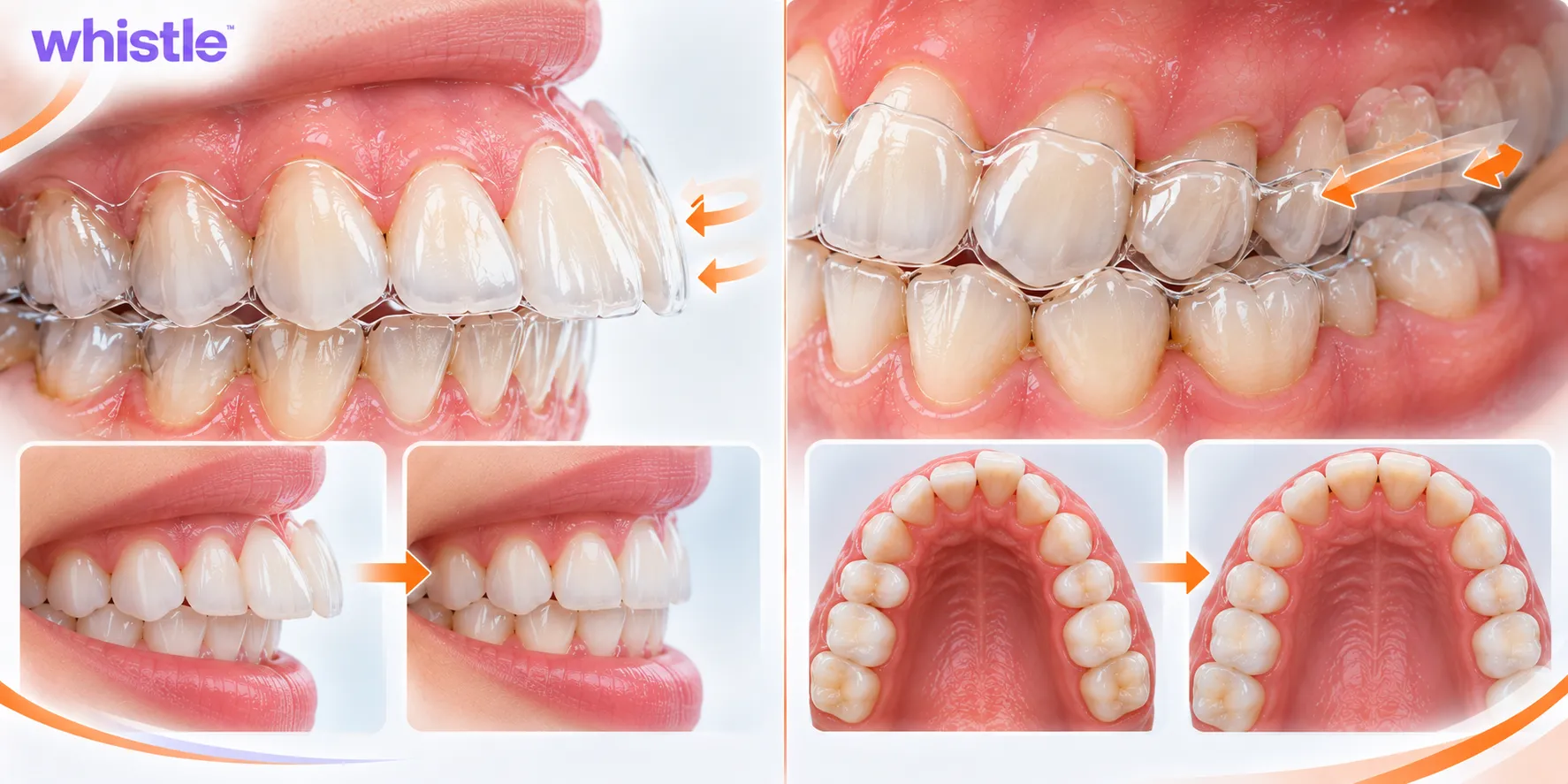
If your upper or lower front teeth stick out, flare forward, or create an overjet (often called buck teeth), your doctor uses retraction. The aligner trays apply gentle backward pressure on your six front teeth (the four incisors and two canines), drawing them backward into a flatter, more balanced arch. This closes gaps, improves your side profile, and protects protruding teeth from getting chipped in accidental falls.
2. Distalization: Pushing Back Chewing Molars Further Back
Distalization means moving your back teeth (molars and premolars) deeper toward the back of your mouth. In the past, dentists often had to pull out two or four healthy bicuspid teeth just to create room in a crowded mouth. Today, orthodontists use clear aligners to push the entire line of molars backward one by one. This backward shift creates valuable millimeters of space across the arch, allowing crowded front teeth to uncross without pulling any permanent teeth.
Can Aligners Push Teeth Back into Place After Relapse?
If your teeth have shifted, do not try to squeeze your old, tight plastic retainer back over your teeth. An old retainer is molded to your past tooth positions, not your current ones. Forcing it down exerts uncontrolled, sudden pressure that can pinch your gums, strip periodontal ligaments, and cause irreversible tooth root death.
Always have a doctor take a fresh 3D scan so a new, gentle set of trays can safely guide your teeth back into place.
How Aligners Push Teeth Back: The Biomechanical Science Made Simple
How does a smooth piece of medical-grade plastic push a sturdy tooth rooted in bone? It relies on natural human biology and precision computerized planning:
1. Staged Micro-Movements (0.2 to 0.3 mm Per Tray)
You cannot simply push a tooth backward all at once. Your jawbone needs time to dissolve microscopic bone cells on the pressure side and lay down fresh new bone cells on the tension side (a biological process called bone remodeling). Each clear aligner tray is engineered to move a tooth only 0.2 to 0.3 millimeters. You wear each tray for one to two weeks, giving your bone and gums time to adjust before moving on to the next tray.
2. Tooth-Colored Smart Attachments (The Handle Effect)
Because plastic trays are naturally smooth, they need extra grip to pull teeth backward bodily rather than just tipping them. Your orthodontist bonds tiny, tooth-colored composite shapes (called attachments) onto specific teeth. These act like miniature handles that give the aligner plastic a firm edge to push against, directing force straight down the root axis.
3. Sequential Distalization (The Domino Strategy)
If you tried to push all your upper teeth backward at the same time, the aligner would simply pop off your front teeth because your back molars are huge and have multiple deep roots. Instead, doctors program the software to move teeth sequentially like dominoes in reverse. First, the second molar moves back 2 millimeters while all the other teeth act as anchors. Once it reaches its spot, the first molar moves back, followed by the premolars, and finally the front incisors slide backward into the open room.
4. Intermaxillary Elastics (Rubber Bands)
For patients who need to pull protruding front teeth backward significantly, clear aligners use small, discreet rubber bands connected between your upper aligner hooks and lower back molars. These elastics provide steady, continuous backward traction that guides the entire upper arch into harmony with your lower jaw.
5. Interproximal Reduction (IPR): Making Space Without Pulling Teeth
To push front teeth back, there must be empty physical space behind them. Along with moving molars back, orthodontists frequently use IPR. This is a gentle, painless polishing of a tiny fraction of a millimeter (0.2 to 0.5 mm) of outer enamel between teeth. It requires no needles or numbing, preserves your tooth health, and creates the exact room needed to slide protruding front teeth inward.
How Many Millimeters Can Aligners Realistically Push Teeth Back?
Clear aligners are remarkably capable, but they work within the natural boundaries of your facial bone structure:
- Flared Front Teeth Retraction: Aligners can routinely move front teeth backward by 2 to 4 millimeters. In cases where extractions were already performed, aligners can retract front teeth by 5 to 7 millimeters to close extraction gaps completely.
- Molar Distalization: Back molars can typically be moved backward by 2 to 3 millimeters per quadrant using sequential staging. When combined with temporary anchorage devices (TADs, or tiny mini-screws placed temporarily in the bone), skilled orthodontists can achieve up to 4 to 5 millimeters of molar distalization.
- Biological Limits: A tooth can only move as far as there is healthy alveolar bone to support its root. If a tooth is pushed beyond the natural bone boundary, the root can hit cortical bone or poke through the gum wall. This is why a clinical 3D scan and X-ray assessment are mandatory before any tooth is pushed backward.
Diagnostic Timeline & Movement Matrix
| Movement Goal | Distance Needed | Primary Tools Used | Estimated Duration | Extraction Needed? |
| Minor Relapse Correction | 0.5 mm to 1.5 mm | Clear Aligners alone (short touch-up series) | 3 to 5 months | No |
| Moderate Front Teeth Retraction | 2 mm to 3 mm | Aligners + Attachments + Light IPR | 6 to 9 months | No |
| Significant Molar Distalization | 2 mm to 4 mm | Sequential Aligner staging + Elastics | 10 to 15 months | No |
| Severe Protrusion / Major Overjet | 5 mm to 7 mm+ | Aligners + Elastics / TADs or Premolar extraction | 14 to 20 months | Evaluated case by case |
5 Common Mistakes to Avoid When Pushing Teeth Back
- Falling Below the 20 to 22 Hours Daily Wear Rule: Pushing teeth backward requires continuous bone remodeling. If you take your aligners out for several hours during the day, the periodontal fibers pull the teeth forward again, stalling progress and causing your trays to lose their grip.
- Forcing an Old Retainer: As emphasized, squeezing an old retainer over shifted teeth puts dangerous, uncontrolled twisting pressure on your roots and can lead to permanent nerve death.
- Using DIY Mail-Order Trays Without Doctor Supervision: Moving teeth backward is one of the most biomechanically complex movements in dentistry. Mail-order aligner kits lack attachment handles, elastics, and in-person X-rays, frequently tipping crowns outward while leaving roots stuck in bone.
- Ignoring Habitual Tongue Thrusting: If your tongue constantly presses against the back of your front teeth when you swallow, it exerts tons of pressure forward. If this habit is not addressed, your front teeth will push forward again as soon as treatment ends.
- Skipping Nighttime Retainers After Movement: Teeth naturally want to drift forward throughout life (mesial drift). Wearing your clear retainer every night protects your investment and ensures your teeth stay locked in their healthy, retracted position.
Your Next Steps: Find Out If Aligners Can Move Your Teeth Back
Whether you want to bring in protruding front teeth, create room without extractions, or fix teeth that have shifted after teenage braces, a professional clinical assessment will give you exact answers.
At a Whistle partner clinic, our certified orthodontists will:
- Perform a 3D digital scan to capture every millimeter of your tooth positions and arch width.
- Take digital X-rays to measure your jawbone thickness and verify root health.
- Create a computerized 3D smile simulation showing exactly how your teeth will move backward week by week.
- Provide an honest, personalized treatment plan with transparent planning and flexible zero-interest payment assistance.
Take the first step toward a straight, comfortable smile today. Book your 3D digital smile assessment at a Whistle partner clinic near you.
Book 3D Teeth Scan
Consult our experts and get a 3D preview of your smile transformation!
Can Aligners Push Teeth Back
FAQ's
Q1.Can aligners push my front teeth back if they stick out?
Yes. Retracting flared front teeth is one of the most common and successful treatments performed with clear aligners. By creating subtle space with light enamel polishing (IPR) or moving back molars, aligners smoothly draw protruding front teeth inward.
Q2.Does pushing teeth back hurt more than regular straightening?
No. You will feel mild tightness and pressure for the first two to three days after switching to a new tray, especially around the teeth that are actively being moved. This pressure is a normal sign that bone remodeling is happening and is easily managed with soft foods.
Q3.How long does it take to push back teeth that moved after braces?
Minor post-braces shifting can often be fully corrected in 3 to 6 months with a short series of touch-up aligners. Your doctor will take a digital scan to show you exactly how many trays you will need.
Q4.Will pushing my teeth back change my face shape?
Yes, in a positive way. When flared front teeth are brought backward into proper alignment, your lips can close naturally without straining. This often softens your facial profile, reduces lip protrusion, and gives your smile a balanced, relaxed appearance.

 Medically Reviewed by Whistle Dental Team


 Medically Reviewed by Whistle Dental Team









 Medically Reviewed by Whistle Dental Team